Buy astrologieforum.eu ?
We are moving the project
astrologieforum.eu .
Are you interested in purchasing the domain
astrologieforum.eu ?
domain@kv-gmbh.de · 0541-91531010
Buy astrologieforum.eu ?
Do people often confuse astrology with astronomy?
Yes, people often confuse astrology with astronomy. While both fields involve studying celestial bodies, they are fundamentally different. Astronomy is a scientific study of the universe, focusing on the physical properties and movements of celestial objects. On the other hand, astrology is a belief system that suggests a connection between the positions of celestial bodies and events on Earth, often used for making predictions about individuals' personalities and future. **
What professions are there in astronomy/astrology?
In astronomy, there are various professions such as astronomers, astrophysicists, cosmologists, and planetary scientists. Astronomers observe and study celestial objects and phenomena, while astrophysicists focus on the physical properties and processes of celestial bodies. Cosmologists study the origins and evolution of the universe, and planetary scientists specialize in the study of planets, moons, and other objects in our solar system. In astrology, there are professions such as astrologers who interpret the positions and movements of celestial bodies to make predictions and provide guidance to individuals based on their birth charts. **

Similar search terms for Astronomy
Top-Angebote
Products related to Astronomy:
-
Inspire Essentials Mechanical Solar System Orrery Model Metal Astronomy Desk Decor Mechanical Solar System Orrery Model Metal Astronomy Desk DecorBring the wonder of the universe right to your desk with this captivating solar system model designed to inspire curiosity and conversation. Crafted for space enthusiasts students and collectors this elegant piece showcases planetary motion in a...67,48 $*Shipping: 0,00 $Secure redirect to the provider
-
Inspire Curations Grand Mechanical Orrery Solar System Model Metal Astronomy Desk Decor & Collectors Display Grand Mechanical Orrery Solar System Model Metal Astronomy Desk Decor & Collectors DisplayExplore the beauty of the universe from your own desk with this stunning orrery solar system model. Designed as both a decorative masterpiece and an educational tool, it brings planetary motion to life through intricate mechanical design. Perfect...90,50 $*Shipping: 0,00 $Secure redirect to the provider
-
Collins 2024 Guide to the Night Sky Book – Astronomy & Stargazing CollectionFrom the UK’s Number One Astronomy publisher, this is the bestselling stargazing handbook to the planets, stars and constellations visible from the northern hemisphere. With 6 pages for each month covering January–December 2024. This practical guide is an easy introduction to astronomy and a useful reference for seasoned stargazers. Designed for Britain and Ireland but usable anywhere in the world between 40°N and 60°N, covering most of Europe, southern Canada and the northern United States. Advice on where to start looking and a map of dark sky sites to avoid light pollution. Charts for the circumpolar and seasonal constellations. Easy-to-use star charts for each month with descriptions of objects and events to look for in 2024. Positions of the moon, visible planets and eclipses. Includes a section on comets and a detailed map of the moon. Now in three editions: Britain and Ireland; North America; Southern Hemisphere. Written and illustrated by astronomical experts, Storm Dunlop and Wil Tirion, and approved by the astronomers of the Royal Observatory Greenwich.1,99 £*Shipping: 1,99 £Secure redirect to the provider


-
Is that astronomy if I am really interested in stars and planets?
Yes, being interested in stars and planets falls under the realm of astronomy. Astronomy is the scientific study of celestial objects such as stars, planets, and galaxies, as well as the phenomena that occur outside Earth's atmosphere. If you have a genuine interest in learning about and observing stars and planets, then you are definitely engaging in the study of astronomy. **
-
Is that astronomy if I am incredibly interested in stars and planets?
Yes, being incredibly interested in stars and planets falls under the realm of astronomy. Astronomy is the scientific study of celestial objects such as stars, planets, comets, and galaxies, as well as the phenomena that occur outside the Earth's atmosphere. Your fascination with stars and planets aligns with the core principles of astronomy, making it a suitable field for your interest. **
-
Are all stars suns in astronomy?
No, not all stars are considered suns in astronomy. The term "sun" specifically refers to the star at the center of our solar system, which we commonly refer to as the Sun with a capital "S". Other stars in the universe are also referred to as stars, not suns, unless they are the central star of their own solar system. So, while the Sun is a star, not all stars are considered suns in astronomy. **
-
What is the difference between astronomy and astrology?
Astronomy is the scientific study of celestial objects and phenomena, such as stars, planets, and galaxies. It involves the observation and analysis of these objects using physics and mathematics. On the other hand, astrology is a belief system that suggests a connection between the positions and movements of celestial bodies and events on Earth, as well as the personalities and destinies of individuals. While astronomy is a science based on empirical evidence and observation, astrology is considered a pseudoscience and lacks empirical support. **


How can one learn astronomy and astrology as professions?
One can learn astronomy and astrology as professions by pursuing a formal education in these fields. For astronomy, one can earn a degree in astronomy, physics, or a related field from a university. This will provide a strong foundation in scientific principles and observational techniques. For astrology, one can study with experienced astrologers, take courses in astrology, and pursue certification from reputable astrology organizations. Additionally, gaining practical experience through internships, research projects, and networking with professionals in the field can also be valuable for both astronomy and astrology careers. **
What is the literal difference between astrology and astronomy?
The literal difference between astrology and astronomy is that astrology is the study of the positions and movements of celestial bodies in relation to their supposed influence on human affairs and natural phenomena, while astronomy is the scientific study of celestial objects, space, and the universe as a whole. In other words, astrology is a belief system that suggests a connection between the positions of celestial bodies and human events, while astronomy is a branch of science that seeks to understand the physical properties and behavior of celestial objects. **
Top-Angebote
Products related to Astronomy:
-
Arcturus Children's Encyclopedia of Space by Giles Sparrow Visual Guide to the Universe, Planets, Stars & Solar System Astronomy Reference Book for KidsJourney beyond Earth and discover the wonders of the cosmos with Children's Encyclopedia of Space: A Visual Guide to the Universe by Giles Sparrow. Part of the Arcturus Children's Reference Library, this engaging visual encyclopedia introduces young readers to the fascinating world of space, astronomy and the universe. Explore the Solar System, planets, moons, stars, galaxies and other extraordinary objects in space while developing an understanding of the vast universe beyond our planet. Presented as an accessible visual reference guide, the book makes complex astronomical topics engaging and easier for young readers to explore. Ideal for children fascinated by planets, stars, space exploration and astronomy, this encyclopedia encourages curiosity and provides a useful resource for independent reading, homework, school projects and general knowledge. Whether learning about our neighbouring planets or exploring the mysteries of distant stars and galaxies, Children's Encyclopedia of Space is a valuable addition to any young space enthusiast's bookshelf. Key Features Engaging children's space encyclopedia Written by astronomy author Giles Sparrow A visual guide to the universe and outer space Explores planets, stars, moons, galaxies and the Solar System Introduces astronomy in an accessible format for young readers Ideal for school projects, homework and independent learning Part of the Arcturus Children's Reference Library Excellent educational gift for young space and science enthusiasts5,99 £*Shipping: 2,99 £Secure redirect to the provider
-
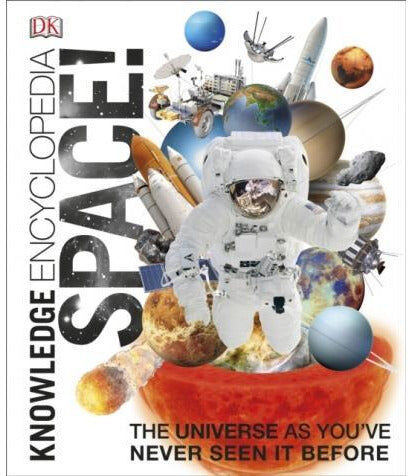
Dorling Kindersley DK Knowledge Encyclopedia Space The Ultimate Space & Astronomy Reference Guide for Kids and Families - Planets, Stars, Galaxies & the Universe ExplainExplore the wonders of the universe with the DK Knowledge Encyclopedia Space, an inspiring and visually stunning guide to outer space.Packed with high-definition photographs, 3D illustrations, infographics, facts, timelines, and scientific explanations, this encyclopedia takes readers on an unforgettable journey from Earth to the farthest reaches of the cosmos. Perfect for curious readers, young astronomers, and space enthusiasts, this book explains: The solar system, planets, moons, and dwarf planets Stars, nebulas, black holes, galaxies & cosmic phenomena Space exploration, astronauts & spacecraft The Big Bang, universe evolution & future missions The latest science discoveries explained in kid-friendly language A brilliant educational book for STEM learners, classrooms, home libraries, and children aged 8–14 who love space.9,99 £*Shipping: 2,99 £Secure redirect to the provider
-
Inspire Essentials Mechanical Solar System Orrery Model Metal Astronomy Desk Decor Mechanical Solar System Orrery Model Metal Astronomy Desk DecorBring the wonder of the universe right to your desk with this captivating solar system model designed to inspire curiosity and conversation. Crafted for space enthusiasts students and collectors this elegant piece showcases planetary motion in a...67,48 $*Shipping: 0,00 $Secure redirect to the provider
-
Do people often confuse astrology with astronomy?
Yes, people often confuse astrology with astronomy. While both fields involve studying celestial bodies, they are fundamentally different. Astronomy is a scientific study of the universe, focusing on the physical properties and movements of celestial objects. On the other hand, astrology is a belief system that suggests a connection between the positions of celestial bodies and events on Earth, often used for making predictions about individuals' personalities and future. **
-
What professions are there in astronomy/astrology?
In astronomy, there are various professions such as astronomers, astrophysicists, cosmologists, and planetary scientists. Astronomers observe and study celestial objects and phenomena, while astrophysicists focus on the physical properties and processes of celestial bodies. Cosmologists study the origins and evolution of the universe, and planetary scientists specialize in the study of planets, moons, and other objects in our solar system. In astrology, there are professions such as astrologers who interpret the positions and movements of celestial bodies to make predictions and provide guidance to individuals based on their birth charts. **
-
Is that astronomy if I am really interested in stars and planets?
Yes, being interested in stars and planets falls under the realm of astronomy. Astronomy is the scientific study of celestial objects such as stars, planets, and galaxies, as well as the phenomena that occur outside Earth's atmosphere. If you have a genuine interest in learning about and observing stars and planets, then you are definitely engaging in the study of astronomy. **
-
Is that astronomy if I am incredibly interested in stars and planets?
Yes, being incredibly interested in stars and planets falls under the realm of astronomy. Astronomy is the scientific study of celestial objects such as stars, planets, comets, and galaxies, as well as the phenomena that occur outside the Earth's atmosphere. Your fascination with stars and planets aligns with the core principles of astronomy, making it a suitable field for your interest. **
Similar search terms for Astronomy
-
Inspire Curations Grand Mechanical Orrery Solar System Model Metal Astronomy Desk Decor & Collectors Display Grand Mechanical Orrery Solar System Model Metal Astronomy Desk Decor & Collectors DisplayExplore the beauty of the universe from your own desk with this stunning orrery solar system model. Designed as both a decorative masterpiece and an educational tool, it brings planetary motion to life through intricate mechanical design. Perfect...90,50 $*Shipping: 0,00 $Secure redirect to the provider
-
Collins 2024 Guide to the Night Sky Book – Astronomy & Stargazing CollectionFrom the UK’s Number One Astronomy publisher, this is the bestselling stargazing handbook to the planets, stars and constellations visible from the northern hemisphere. With 6 pages for each month covering January–December 2024. This practical guide is an easy introduction to astronomy and a useful reference for seasoned stargazers. Designed for Britain and Ireland but usable anywhere in the world between 40°N and 60°N, covering most of Europe, southern Canada and the northern United States. Advice on where to start looking and a map of dark sky sites to avoid light pollution. Charts for the circumpolar and seasonal constellations. Easy-to-use star charts for each month with descriptions of objects and events to look for in 2024. Positions of the moon, visible planets and eclipses. Includes a section on comets and a detailed map of the moon. Now in three editions: Britain and Ireland; North America; Southern Hemisphere. Written and illustrated by astronomical experts, Storm Dunlop and Wil Tirion, and approved by the astronomers of the Royal Observatory Greenwich.1,99 £*Shipping: 1,99 £Secure redirect to the provider
-
Philip's Night Sky Atlas By Philip - Essential Astronomy Non Fiction - PaperbackTitle:. Philip's Night Sky Atlas Format: Paperback Overview:. Discover the wonders above with Philip's Night Sky Atlas, a trusted compass for navigating the heavens. Whether you are standing in your garden tracing Orion's Belt or preparing for a weekend camping trip away from city lights, this essential astronomy guide brings the universe down to earth. Designed as a comprehensive yet accessible reference, the atlas features meticulously crafted maps that help readers locate stars, constellations, and deep-sky objects with confidence. Each chart provides a clear view of current stellar positions, allowing you to plan observation sessions in advance. The charts assist in distinguishing between brighter stars visible to the naked eye and fainter clusters that reward binocular observation. Users can compare the printed sky positions against their real-time observations, building a stronger mental model of celestial motion over time. This iterative process cements knowledge far more effectively than scrolling through a screen, fostering genuine astronomical literacy. As a staple in the renowned Philip's atlas collection, this book upholds a legacy of accuracy and clarity that has supported astronomy learners across generations, bridging the gap between casual curiosity and structured learning. What Makes This Book Stand Out:. What elevates Philip's Night Sky Atlas above standard star guides is its balance of practicality and visual appeal. Many astronomical books struggle to translate three-dimensional space onto two-dimensional pages, but this atlas excels at presenting readable projections that match what the eye sees through unaided vision. The maps are organised effectively, eliminating confusion when scanning the sky during fleeting moments under the stars. A major advantage of this paperback format is its portability; unlike heavy hardback references kept safely indoors, this version is built to accompany you outside. The durable cover withstands handling in variable lighting conditions, making it equally suited for quick checks during a night walk as it is for desk-based planning. The choice of illustration style plays a crucial role here; the maps avoid clutter, prioritising essential lines and labels so that even under poor lighting conditions—such as using a red torch for star-hopping—the text remains legible. This attention to user experience ensures the book functions reliably when used practically rather than just read passively. Furthermore, the internal illustrations capture the artistic heritage of astronomy, depicting constellations with contextual figures that aid memory retention. Who This Book Is Perfect For:. This atlas is tailored for a wide spectrum of astronomy enthusiasts, starting with the complete beginner who feels overwhelmed by apps and prefers tactile references. Families with young astronomers will find it invaluable for teaching children how to orient themselves under the stars, turning evening routines into...14,99 £*Shipping: 2,99 £Secure redirect to the provider
-
Are all stars suns in astronomy?
No, not all stars are considered suns in astronomy. The term "sun" specifically refers to the star at the center of our solar system, which we commonly refer to as the Sun with a capital "S". Other stars in the universe are also referred to as stars, not suns, unless they are the central star of their own solar system. So, while the Sun is a star, not all stars are considered suns in astronomy. **
-
What is the difference between astronomy and astrology?
Astronomy is the scientific study of celestial objects and phenomena, such as stars, planets, and galaxies. It involves the observation and analysis of these objects using physics and mathematics. On the other hand, astrology is a belief system that suggests a connection between the positions and movements of celestial bodies and events on Earth, as well as the personalities and destinies of individuals. While astronomy is a science based on empirical evidence and observation, astrology is considered a pseudoscience and lacks empirical support. **
-
How can one learn astronomy and astrology as professions?
One can learn astronomy and astrology as professions by pursuing a formal education in these fields. For astronomy, one can earn a degree in astronomy, physics, or a related field from a university. This will provide a strong foundation in scientific principles and observational techniques. For astrology, one can study with experienced astrologers, take courses in astrology, and pursue certification from reputable astrology organizations. Additionally, gaining practical experience through internships, research projects, and networking with professionals in the field can also be valuable for both astronomy and astrology careers. **
-
What is the literal difference between astrology and astronomy?
The literal difference between astrology and astronomy is that astrology is the study of the positions and movements of celestial bodies in relation to their supposed influence on human affairs and natural phenomena, while astronomy is the scientific study of celestial objects, space, and the universe as a whole. In other words, astrology is a belief system that suggests a connection between the positions of celestial bodies and human events, while astronomy is a branch of science that seeks to understand the physical properties and behavior of celestial objects. **
* All prices are inclusive of VAT and, if applicable, plus shipping costs. The offer information is based on the details provided by the respective shop and is updated through automated processes. Real-time updates do not occur, so deviations can occur in individual cases. ** Note: Parts of this content were created by AI.